
Donor support helps create a margin of excellence through scholarships, hands-on learning, and opportunities that give students the support and preparation to pursue their goals in medicine.
For many aspiring physicians, the journey to becoming a doctor begins long before putting on a white coat. It takes shape through challenges, sometimes life-changing events, moments of compassion, and a growing understanding of the communities they will soon serve. Over time, an aspiration becomes a goal, a goal becomes a pursuit, and with the right, life-changing opportunity, a dream can come true.
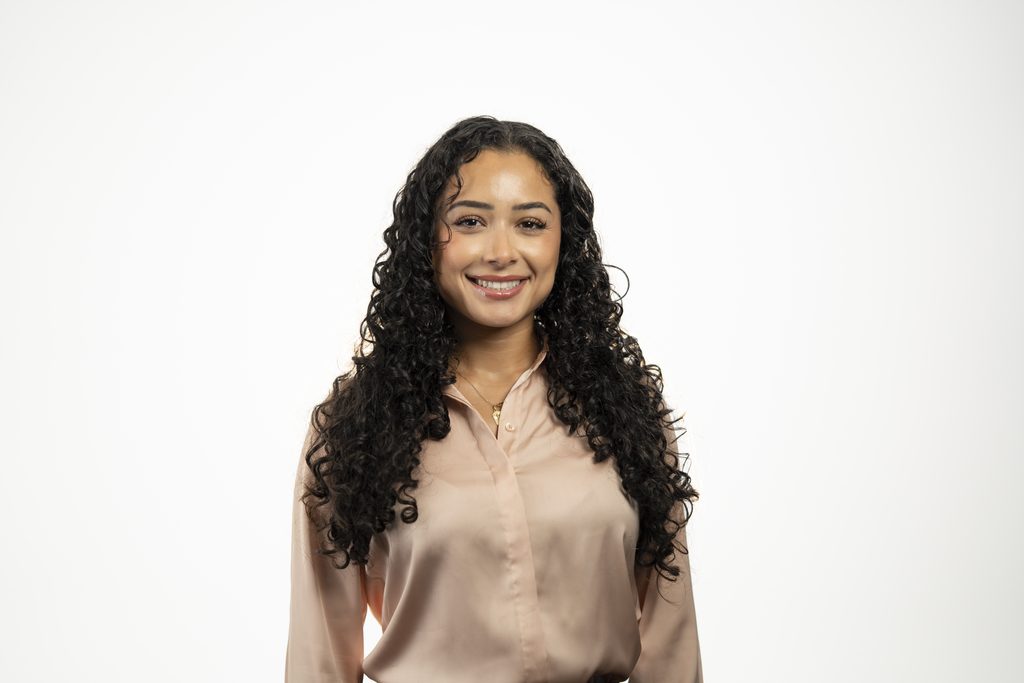
For Camila P., a second-year medical student at the Herbert Wertheim College of Medicine, her dream of becoming a doctor is rooted in caring for others. Far before getting into medical school, she knew that she wanted to be the kind of physician who stood by her patients during some of life’s most difficult moments and share in the moments worth celebrating. Her goal: become a pediatrician to help children and families develop healthy lifestyles from an early age and change outcomes for underserved communities. She looks forward to standing beside her patients when they need her most.
Camila earned her Bachelor of Science in Biomedical Engineering from FIU College of Engineering & Computing. She said her undergraduate degree equipped her with a lot of necessary critical-thinking skills and helped her become comfortable in challenging environments. After graduating, she worked as a bartender to help her afford medical school applications.
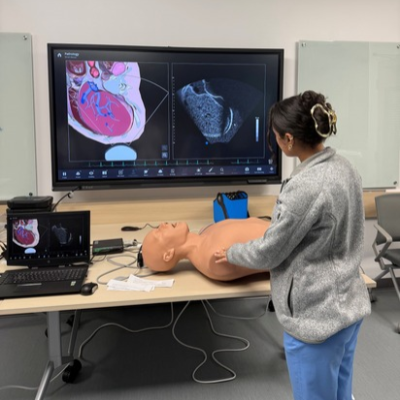
Today, her future is taking shape. As a scholarship recipient, she is able to devote her time and attention to becoming a physician who will care for patients with compassion and positively change lives. She attributes her scholarships, the encouragement of faculty and staff, and hands-on learning experiences at the Albert & Debbie Taño Medical Simulation Center and the entire support of the Herbert Wertheim College of Medicine with helping turn her dream into reality.
At FIU, donor support opens the door to tangible opportunities and real-life experiences that transform aspirations into reality.
Camila’s story offers a glimpse of what donors’ generosity can make possible: a student who began her FIU journey as an undergraduate is now preparing to become a doctor.
Here is her first-hand account of how your generosity and FIU’s commitment to student excellence have positively changed her life and are preparing her for a fulfilling career in medicine:
Q: Before coming to FIU, what did you think was possible for you, and what feels possible now?
Camila: I am a first-generation American, and I am going to be a doctor. Before FIU, I definitely wanted to be a doctor, but it felt very distant. Now, I know that it is not “I want to be a doctor,” it is “I will be a doctor.” There is a lot of power in that shift.
Feeling like I am surrounded by like-minded people who come from similar backgrounds and understand what it is like to have to translate for your parents when you are young or figure out how to explain to your grandparents what the doctor just said. [Faculty and staff] understand that we are coming from really diverse backgrounds. A lot of us had really difficult journeys to get to where we are today, and they celebrate that. So, FIU has given me not only the hard skills, like critical thinking, but confidence in myself and in my future, and a lot of gratitude for the opportunities that I have, which are definitely going to play a role in being a great physician.
Q: What first drew you to healthcare?
Camila: As a young girl who was good at math and science, [healthcare] was definitely encouraged by my parents and my teachers. I do not remember there being any representation as a young girl of female doctors. Then early in college, someone really important to me passed away, and that was my first time experiencing a big loss and, being in the setting of an emergency room – people rushing, loud sounds, helicopters – it was really a crazy experience, and all I could think about in the moment was I am on the receiving end of what I have always seen in movies and shows, like Grey’s Anatomy. I was watching everything unfold, trying to understand and grasp my new reality. That [moment] shifted healthcare from something I was just interested in to a career that I definitely wanted to dedicate myself to. I would like to walk with people when it comes to these moments, and I want to deliver good news and celebrate with these families too. I want to walk with [patients] in their journeys.
Q: What opportunity at FIU has had the greatest impact on you, and what has it taught you about the kind of physician you want to become?
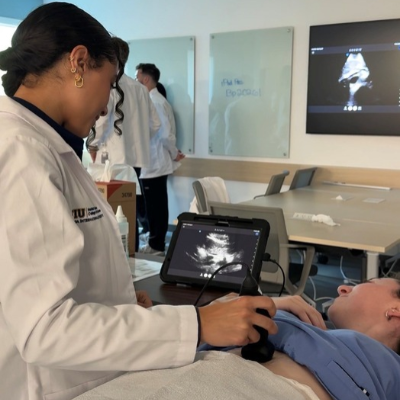
Camila: The Student Faculty Collaborative Clinic. It is a clinic that we run in Opa-locka with the Herbert Wertheim College of Medicine students and the on-site faculty. We provide resources from preventative care to screenings. Working with these patients has really shown me the barriers and the social determinants of health at play. This is a very vulnerable population that puts a lot of trust in us to provide them with care and attention and a space to share their concerns. It has been a really beautiful experience. This experience taught me that we have to meet patients where they are. We can try to treat a diagnosis, but it is not going to be a great outcome if [patients] do not understand their diagnosis, they do not have the means to get their medicine or their follow-ups, or [they do not] feel comfortable enough to ask questions. So, I definitely think we have to be more culturally aware and be able to sit down with our patients, assess their barriers, and see what we can do to bridge that gap.
Q: What would you say to donors who make so many experiences possible for FIU students?
Camila: I do not have enough words to say thank you, so I will just say, “Thank you, thank you, thank you!” Medicine felt like a very distant dream. I knew I wanted to be a doctor, but I did not know how I was going to get there. I just knew I had to get there for me and for my family, and FIU donors have made that possible.
Thankfully, I am on scholarship right now for the Herbert Wertheim College of Medicine. It has alleviated so much stress for me and my family. I can just focus on my studies. I am very, very grateful for the opportunity I have, and I do not take it for granted.
Philanthropy goes far beyond just tuition payments. I see it at play every day in school. I am going to learn how to place a catheter. I learned how to place a nasogastric tube. All of these things have been possible thanks to the Albert and Debbie Taño Medical Simulation Center and all of the equipment that we have at the Herbert Wertheim College of Medicine. It has definitely enhanced our experience. And, we have all the support [from faculty]who are patient. The simulation lab gives [us] a lot of confidence. We no longer have to sit around and only read textbooks all day or just go to lecture and wait until rotations or residency to get our hands on something that feels like medicine. We see it every single day, and our curriculum does such a good job at incorporating hands-on learning. It has made learning so much better. The Herbert Wertheim College of Medicine prepares us very well for residency when we are in a room full of doctors and have to place a catheter for the first time in front of everyone. We can think back and say, “Thank God FIU had a simulation center.”